
Sergiy Salo has spent his life performing in concert halls. But the audiences he prefers are the people who sit on public benches in the streets of Seoul.
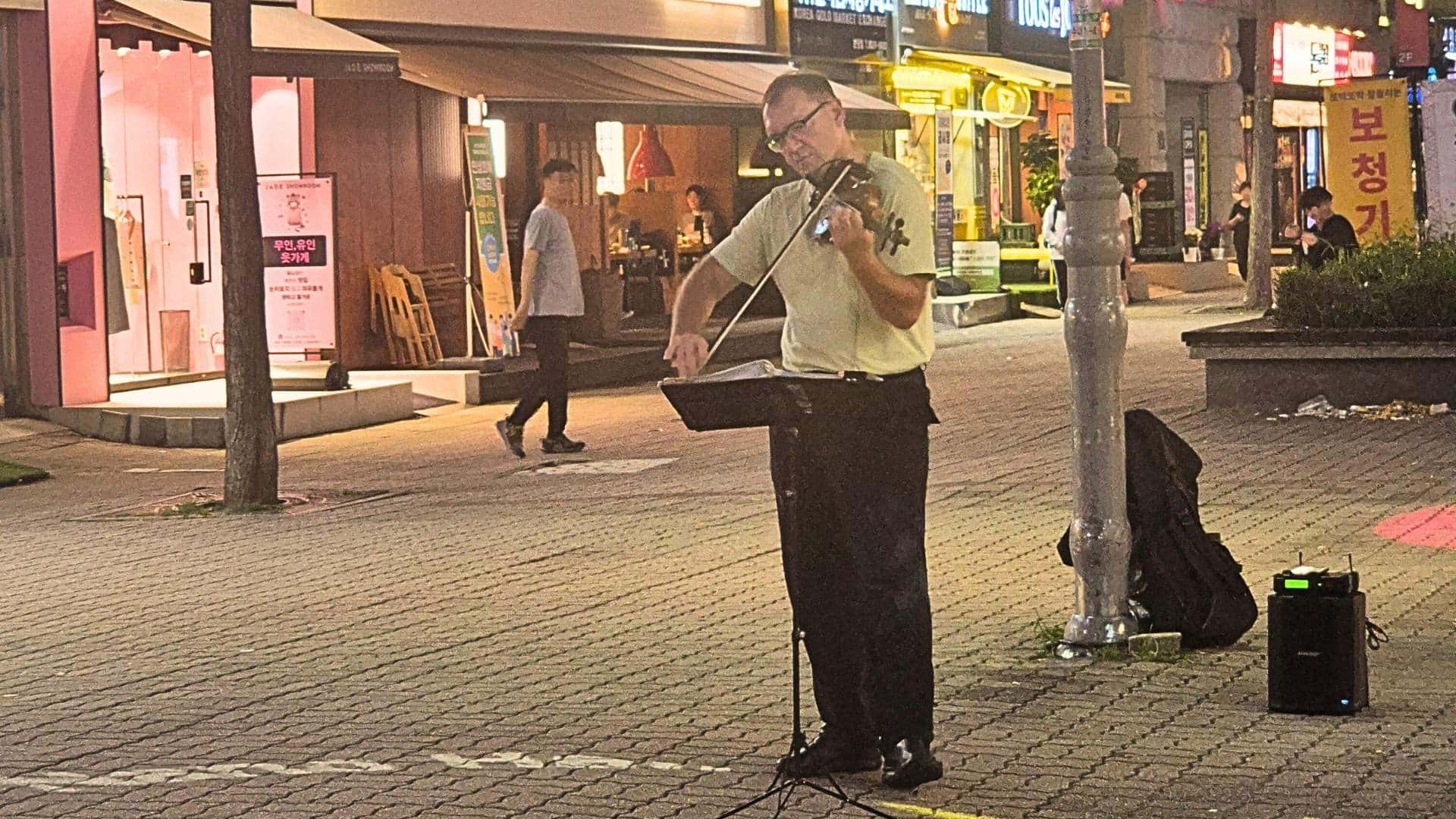
Sergiy Salo performs on the street in Seoul, South Korea. (Photo by Hannah Choo)
I sit on a public bench in South Korea between a little girl and an elderly grandfather. In front of me, a Ukrainian violinist plays an old Korean folksong. Already, this has struck me as unusual. It is rare to see foreigners in such an ethnically homogenous country like Korea.
And while busking is a popular activity for those who are Korean, I had never seen someone busking here who wasn’t Korean.
But to my greater surprise, the grandfather beside me suddenly begins to sing along in low soulful murmurs that harmonize with the sweet melody of the violin. Just a couple of minutes ago, he had told me that he was wary about why a foreign musician was performing here.
Soon I find myself humming along, and just like that, my life crosses paths with people I would never have otherwise met if I hadn’t chosen to sit here and listen for a minute.
The violinist’s name is Sergiy Salo. He was born in Ukraine, where music became a part of his life at the age of 7. It wasn’t by choice, but rather by the nudging of his mother to pick up an instrument and the youth orchestra had only room for a violin.
“The violin was the only instrument left,” Salo said. “There were no other open positions.”
A life of music
Because his music school only had bows, he carried around a bow for the first six months without its violin counterpart.
Yet, sometime around the fourth or fifth grade, he realized that the violin was his and that he had to be a musician.
At 18, he moved to Russia to study music at a university in St. Petersburg and then subsequently came to Korea in 2000 to play music professionally.
When we talk about playing music professionally, most people envision towering concert halls, polished stages and rows of neatly ordered audience seats, each one earned through an expensive ticket booked in advance.
For years, this was Salo’s life. As concertmaster of the Seoul Pops Orchestra, he led other talented professional musicians, creating performances that melded beloved popular songs with classical music.
Yet, when I met him, he was out in public, bent down at knee level and chatting with an excited Korean little girl who asked him to play “Let It Go” (from the movie “Frozen”) on his violin. On the spot, he pressed play on a simple backtrack and then let his music shine, much to the admiration of the little girl and her parent.
Sergei Salo performing on a street in Seoul, South Korea. Video by Hannah Choo.
Public performances
For the last 6-7 years, Salo has been out busking in public. What started as a suggestion from a friend quickly turned into a hobby and then a lifelong love for these public performances.
He prefers these public performances over performing in concert halls; it is here that he is “free in his choices,” both managing and directing every performance to his taste.
He can also talk to his audience on almost every performance. I often observed him chatting with nearby listeners and taking song requests every few minutes. Though his Korean is limited, it doesn’t stop him from connecting with Korean people of diverse backgrounds and ages. It also doesn’t stop him from researching Korean songs on the internet and curating a diverse but meaningful repertoire of all genres of music.
His mother still lives in Ukraine, a country at war with Russia. He knows that the situation there remains unstable but he believes in peace.
He has advice for young musicians wherever they live and whatever the conditions are around them. “No matter what, don’t stop,” he said.
Music creates community.
Music has been the compass of Salo’s life, and his love for it has kept him from ever putting the instrument down. It even led him to Korea, a country that he might have initially never imagined living in, where he says he will likely never leave.
“I found myself here,” he said.
And when asked what music means to him? He answered in two words: “My life.”
For me, meeting Salo, a Ukrainian violinist, was a pivotal moment. It can be easy to feel like an outsider in a new country, something that Salo acknowledged during the interview. Yet, when I saw his performance, I didn’t see any shyness in his musical expression. Rather, he passionately engaged with his music, playing songs that touched the hearts of everyone who was listening.
I, myself, often feel like a foreigner. While I may look Korean, I still feel the cultural disconnect that comes from growing up in a Western country. Yet, Salo’s performance created a space for me to chat with the nearby Korean listeners, even exchanging phone numbers with some people who I became closer to.
For the first time, I truly felt a sense of belonging to this country. Listening to Mr. Salo’s performance reminded me of the purpose of music: not to impress others, but to connect us beyond our divisions.
Questions to consider:
1. Why does Sergiy Salo perform for free when he can get paid for his performances?
2. How can music bring people together?
3. What music do you appreciate and who do you share that appreciation with?
Hannah Choo is an intern at News Decoder who has lived in Pasadena, California and Seongnam, South Korea.

In week two of our Annual Giving Campaign, we look towards the future of News Decoder. To support News Decoder’s student journalism and internships programs, consider making a gift.
Thanks to your support, News Decoder’s learning experiences reach students and educators worldwide.
Support the school partnerships and student journalism that equips students with the tools to grow into informed, engaged global citizens.